
Williamson County Directory Choices
People directories are most useful when their scope matches the person and time period. Williamson County government listings identify public offices and staff. School listings focus on district and campus contacts. Assessment data ties an assessed owner to a parcel, while a deed index names parties to a recorded document. The Archives and Williamson County Public Library supply the deeper historical layer. They reach people who will never appear in a current staff or license directory.
| Directory | Who It Lists | Keeper | Access |
|---|---|---|---|
| County directory | Departments, officials, and staff contacts | Williamson County | Free category or name search |
| Franklin staff listing | City personnel and work contacts | City of Franklin | Free browse and department filter |
| WCS staff listings | District and school employees | Williamson County Schools | Free name, keyword, and department search |
| Property assessment roll | Assessed parcel owners | Property Assessor | County-linked property search |
| Professional license tools | State-regulated people and firms | Tennessee agencies | Name, license, profession, city, or county |
| Archives name index | People in historic county records | County Archives | Free index, Reading Room, phone, or email |
| Local history collections | Past residents, students, families, and veterans | Williamson County Public Library | Onsite print and microfilm plus digital resources |
A current public employee is best sought through an agency listing. A former student may surface in a yearbook. For a named professional, use the board that regulates the field. For a past resident, combine the Archives reference with library newspapers, family files, or local directories. That shift in source is often more important than adding another spelling of the same name.
Williamson County Staff Directory Searches
The Williamson County directory searches by category, first name, and last name. Categories route readers to offices such as Archives and Museum, County Clerk, courts, Elections, Property Assessor, Register of Deeds, Trustee, and Veteran Services. A department listing may show a staff name, title, email, phone, and an extra phone line. The county directory therefore works both as a person search and as an office-routing tool.
Franklin maintains a separate city staff listing with A to Z tabs, an All view, department selectors, and page controls. The inspected interface displayed 198 entries, twenty per page. Entries may show surname and given name, title, department, phone, and an email link. These are public work contacts, not home details. If a person is absent, call the department’s main line or contact the appropriate municipal clerk. County requests do not cover Franklin or another municipality.
| Name | Given and family name in the public listing |
|---|---|
| Role | Official title or public position |
| Department | Agency, county unit, or city division |
| Work phone | Direct line, extension, or department line when published |
| Official contact link when the agency supplies one |
The Tennessee government directory hub broadens the same search to state departments, the state phone directory, officials, law enforcement agencies, and legislators. The captured state directory shows the official route a Williamson County searcher can use when the role belongs to Tennessee rather than county government.
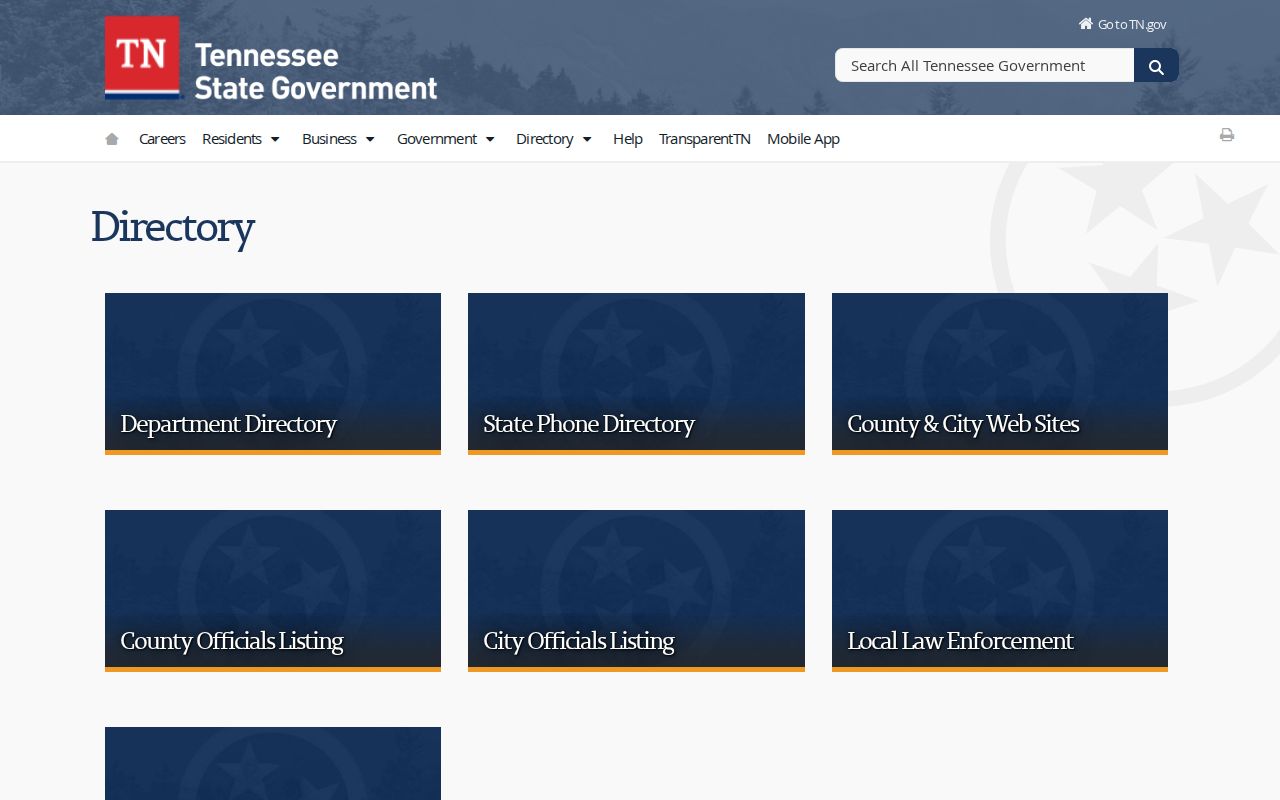
That hub prevents a common routing mistake: a state employee will not necessarily appear in Williamson County’s own staff results.
Williamson County School Directory Fields
Williamson County Schools provides two search blocks. One is for central district staff. The other covers school faculty and staff, with a school chosen through the Department menu. At inspection, the interface exposed 1,206 district constituents and 4,406 school-directory constituents. Those counts make education the largest verified local staff directory in the research, though the public results should not be treated as a guaranteed roster of every district worker.
| Search Field | Type | Required | How It Works |
|---|---|---|---|
| Keyword | Text | No | Broad term across the directory |
| First Name | Text | No | Narrows by given name |
| Last Name | Text | No | Narrows by family name |
| Department | Dropdown | No | Selects a district unit or a school |
A result can supply the person’s name, title, department or school, and email. Search the Williamson County Schools staff directory first by last name, then add a first name or campus if the list is long. Its captured screen also makes the split between district staff and school staff clear.
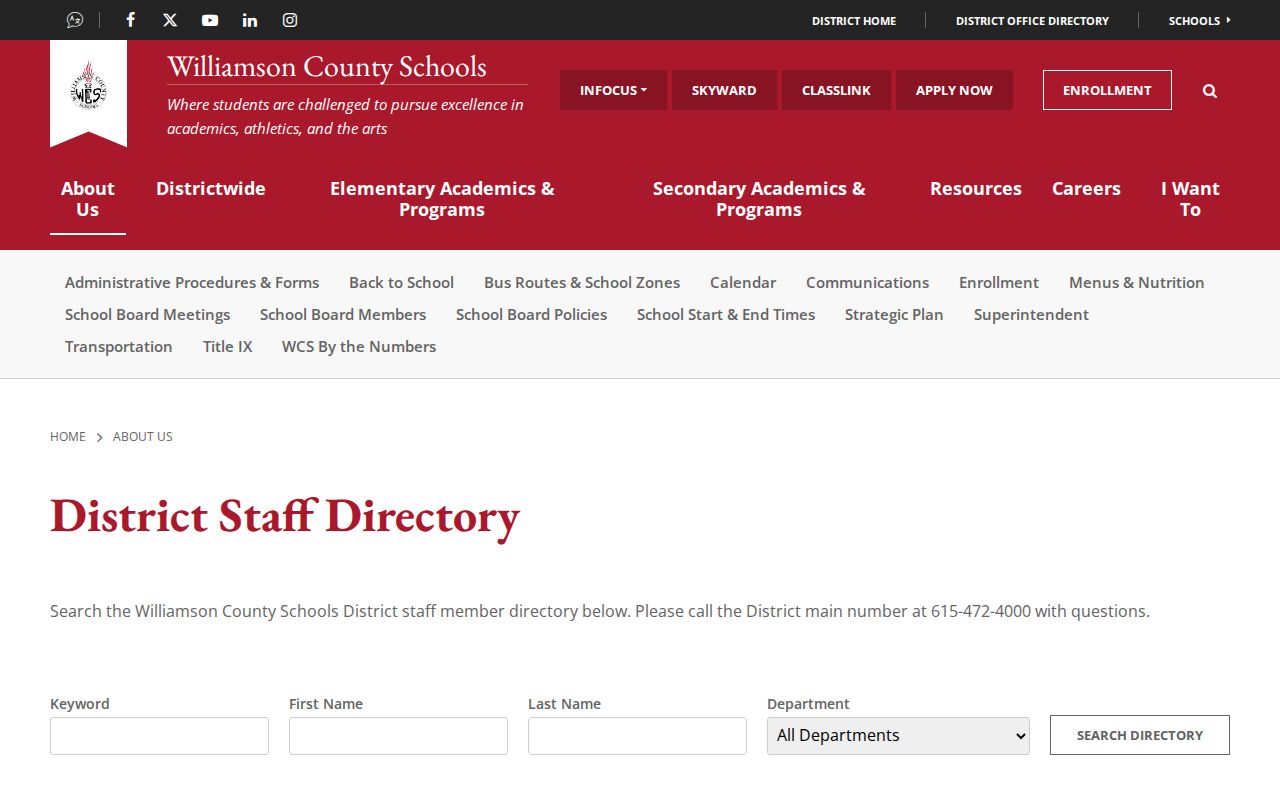
The separate blocks matter because a maintenance or central-office contact may not sit in the same results as a teacher or principal.
Williamson County Professional Directories
Tennessee offers two distinct health-license directory paths. The ordinary verification search fits a known person. It accepts name, city, state, ZIP, profession, and license information, then returns primary-source status that is updated daily. The official page suggests trying only the last name, or the first few letters, when an exact spelling fails. License number is the more direct route when it is known.
The Health Professional Licensing Reports tool takes the opposite approach. It can build a county-oriented list. Board and location are required, while profession, rank, status, and Williamson County can narrow the set. Optional output can include demographics, education and training, practice address and phone, and specialties or qualifications. That makes the report tool useful for discovering who is licensed in a field, while verification is better for checking one known name.
The Tennessee health licensing report builder is shown in the successful directory capture.
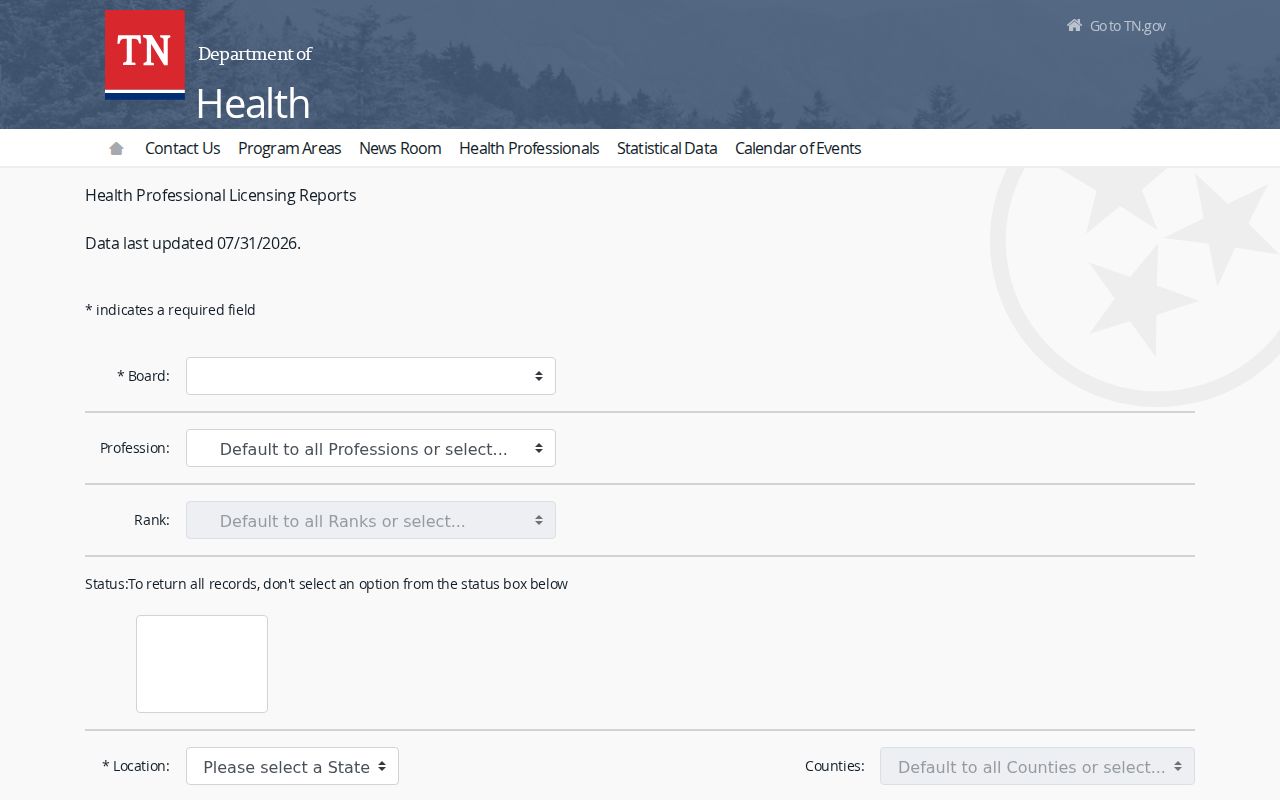
The county filter turns a statewide licensing system into a focused Williamson County professional directory without implying that a practice address is a home address.
Williamson County Commerce License Directory
The Tennessee Department of Commerce and Insurance supplies a broader official directory for regulated individuals and companies. Search modes include an individual or business name, name within a license type, license number, city, or Tennessee county. Its boards cover many regulated fields, including accountancy, barbering and cosmetology, real estate, and contractors. Results can help verify that a seller or service provider has the state credential claimed.
Open the Commerce license and registration search and choose the search type before entering terms. The captured portal shows why a county search and a name search answer different questions.
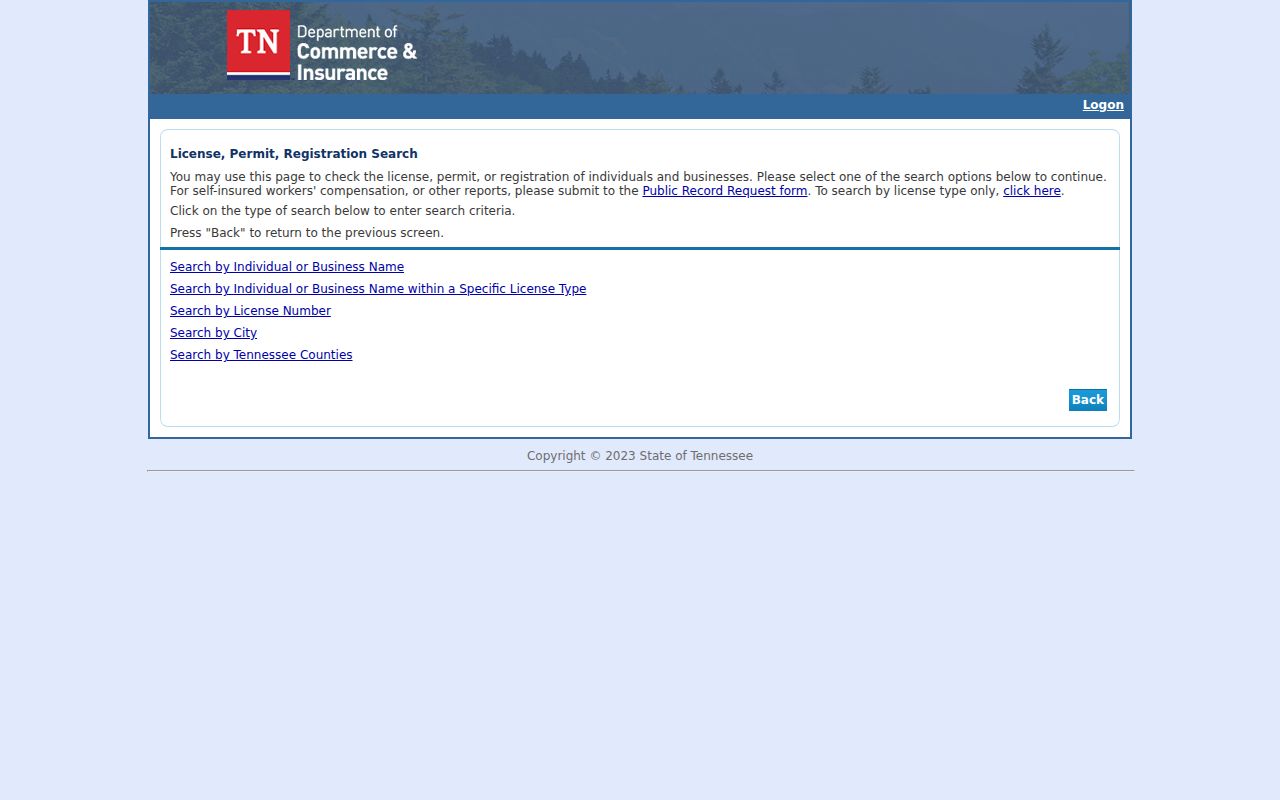
A Williamson County filter can produce a place-based set, while an exact person or company name is the better way to confirm one credential.
Williamson County Property Owner Directories
The official Williamson County property routing page separates three systems: assessment and personal-property data, Register of Deeds records and plats, and Trustee tax or payment data. The Property Assessor maintains ownership records, taxpayer indexes, cadastral maps, and tax rolls. A cadastral map is a parcel-boundary map. Searchers should use the county-linked property application because Tennessee’s statewide parcel program expressly does not maintain Williamson County parcel data.
An assessed owner is not the same as an occupant. A deed party may be a prior owner, lender, trustee, or another party to an instrument. Start with the parcel roll for current assessment context, then use deed records for ownership changes. Modern deed access belongs with the Register of Deeds. Pre-1966 deed work shifts to Archives microfilm. Detailed access rules and copy procedures belong in the Williamson County public records reference.
Note: Postal city, municipal boundary, parcel, election district, and 911 address geography can overlap without describing the same jurisdiction.
Williamson County Archives Name Directory
The county collection gateway describes more than 400,000 indexed entries for court cases, marriages, wills, deeds, and other historical groups. The Archives index About page still says more than 365,000, a sign of continuing additions or a stale count rather than a fixed total. Searchers may browse one record group, search a name across all groups, or select several groups before running the name. Spelling variants, initials, former surnames, and reused family names deserve separate searches.
Each result is a finding aid. It supplies more detail and a reference to microfilm, a bound book, or a loose file. It does not promise a downloadable scan or certified copy. Follow the reference in the Reading Room at 611 W. Main Street in Franklin, call 615-790-5462, or email archives@williamsoncounty-tn.gov to request help or order a copy. The Reading Room is open weekdays from 8:00 to 4:30, with seasonal Saturday hours from May through October.
- Index entry
- A name and citation that points toward the source record.
- Record group
- A set organized by type, such as deeds, marriages, wills, or probate.
- Microfilm
- A photographed record copy read on a viewing machine.
- Grantor and grantee
- The party transferring an interest and the party receiving it in a deed.
The archive’s browse metadata itself needs care. Current ranges include an apparent tax year of “186” and obituary dates reaching 2062. Search broadly, but verify an odd date against the original reference. A directory hit is a route to evidence, not the last word.
Williamson County Library Directories
Williamson County Public Library Special Collections is the main official fallback for printed city directories and school yearbooks. It also holds biographies, Bible records, cemetery and burial material, military and pension records, tax records, historic court files, marriage sources, and periodicals. Microfilm adds Williamson County newspapers, wills and inventories, Works Progress Administration material, and court records. Rare items remain onsite and do not circulate.
Print collection
City directories, yearbooks, family works, local histories, biographies, and cemetery sources in Special Collections.
Microfilm collection
Newspapers, wills, inventories, WPA material, and court records that can connect a name across record types.
Digital collection
Free staff-built databases for births, families, marriages, veterans, African American genealogy, local news, and obituaries.
Exact city-directory, reverse-directory, and telephone-book year runs are not stated on the library overview. Ask Special Collections before planning a year-specific visit. The digital local databases are free from anywhere. Ancestry Library is available in the library, while Fold3 can be reached remotely with a library card.
Williamson County Family History Directories
Some of Williamson County’s strongest people directories were built from community memory rather than current government rosters. The Thelma Battle collection includes thousands of photographs and more than 2,000 funeral programs. Those programs can connect relatives, congregations, burial facts, and community ties. The Richard Carlton Fulcher African American Historical Collection extracts county-court facts about people of African descent from 1799 through emancipation.
The Edythe Rucker Whitley collection holds more than 2,300 genealogy notebooks, with more than half arranged by surname. An online index points into material consulted onsite. Pioneer Families lineage booklets, Historical Society journals published since 1970, and the journal master index add more paths. These sources are especially useful when a surname changed, a person used initials, or a family connection does not appear in a standard civic directory.
For African American research around emancipation, the Archives resource guide adds Freedmen’s Bureau labor contracts from 1865 through 1867 and emancipation and residency records from 1812 through 1857. The contracts and petitions can name people whose lives are thinly documented in conventional directories.
Historical Williamson County People Directories
Williamson County was created from Davidson County in 1799, yet some deed entries begin before county organization. Historical people directories therefore follow the record series, not one tidy starting year. The Archives index shows deeds with scattered 1786 and 1792 material through 1963, plus a 1977 entry; marriages from 1803 through 1987; wills from 1800 through 1987; and probate from 1801 through 2025. Coverage labels do not mean each year or image is complete.
One unusual directory reaches beyond the familiar city book. Ordinary, tavern, and tippling licenses survive in scattered runs from 1800 to 1888. Merchant bonds and licenses span 1823 through 1888. These lists name local operators before modern business databases. St. Paul’s Episcopal registers cover 1827 through 1953 and include baptisms, burials, confirmations, marriages, ministers, parish groups, salaries, and elections. Naturalization records from 1835 through 1885 may also name a former country.
The Archives itself has a local history. County Commission created it in 1993. It later moved from the basement of the Five Points Post Office into the former public-library building, where the archival center and museum opened in 2006. That path helps explain why Williamson County people directories now combine an online index with books, film, loose files, and Reading Room help.