
Which Williamson County Records Are Open
Tennessee law starts with a presumption that government business records are open to Tennessee citizens unless a statute supplies an exception. That rule reaches paper, maps, photographs, microfilm, sound recordings, and electronic files. It does not turn every fact held by government into an unrestricted record. The custodian may withhold sealed, juvenile, adoption, expunged, protected-voter, medical, or other confidential material. Each Williamson County record set also has its own keeper and access path.
| Record Type | Keeper | Online Route | Access Path |
|---|---|---|---|
| Deeds, liens, plats | Register of Deeds | Modern portal linked by office; Archives index for older deeds | Index, counter, microfilm, copy order |
| Circuit and Sessions cases | Circuit Court Clerk | Local inquiry varies; appellate cases use C-Track | Clerk request, court file, appellate search |
| Assessment and parcels | Property Assessor | County property search and GIS | Online data, office, records request |
| Birth, death, marriage, divorce | County Clerk, county health department, courts, state | Applications rather than a broad name index | Eligibility-based certificate or local file |
| Jail and law enforcement | Sheriff or municipal agency | No verified broad county roster | Separate agency request |
| Historic county series | Archives and Museum | Name, keyword, field, and group browsing | Index, Reading Room, remote copy order |
Voter information follows a separate public and confidential split, so a registration self-check is not a countywide person browser. The full access distinctions belong with the Williamson County voter registration search. Likewise, motor vehicle data is not a public address directory. A missing online result may mean the record sits at a counter, in an older volume, with another level of government, or under a valid restriction.
Search Williamson County Archives Records
The Williamson County Archives search is the county's strongest historical name tool. It supports name, keyword, and field modes across deeds, marriages, probate, wills, burials, inquests, road files, taxes, licenses, obituaries, and other groups. A person can search a surname and first name, narrow by one or more record groups, or use keywords with an all-terms or any-term match. Field choices change with the selected group.
| Search Control | Input | How It Narrows Results |
|---|---|---|
| Last Name | Text | Name Search surname |
| First Name | Text | Name Search given name |
| Record Groups | Multi-select | One or several historical series |
| Search Terms | Text | Keyword mode across indexed text |
| Match Type | All or any terms | Controls keyword breadth |
| Record Group | Dropdown | Opens group-specific field choices |
The database is a finding aid, not a promise of a scanned document. A hit usually points to microfilm, a bound volume, or a loose file. The Reading Room provides access, and staff can handle remote copy requests. The county's newer collection page reports more than 400,000 entries, while the index description says more than 365,000. Ongoing additions likely explain the difference.
The Archives deed index shows the actual browse layout used for historical Williamson County public records.
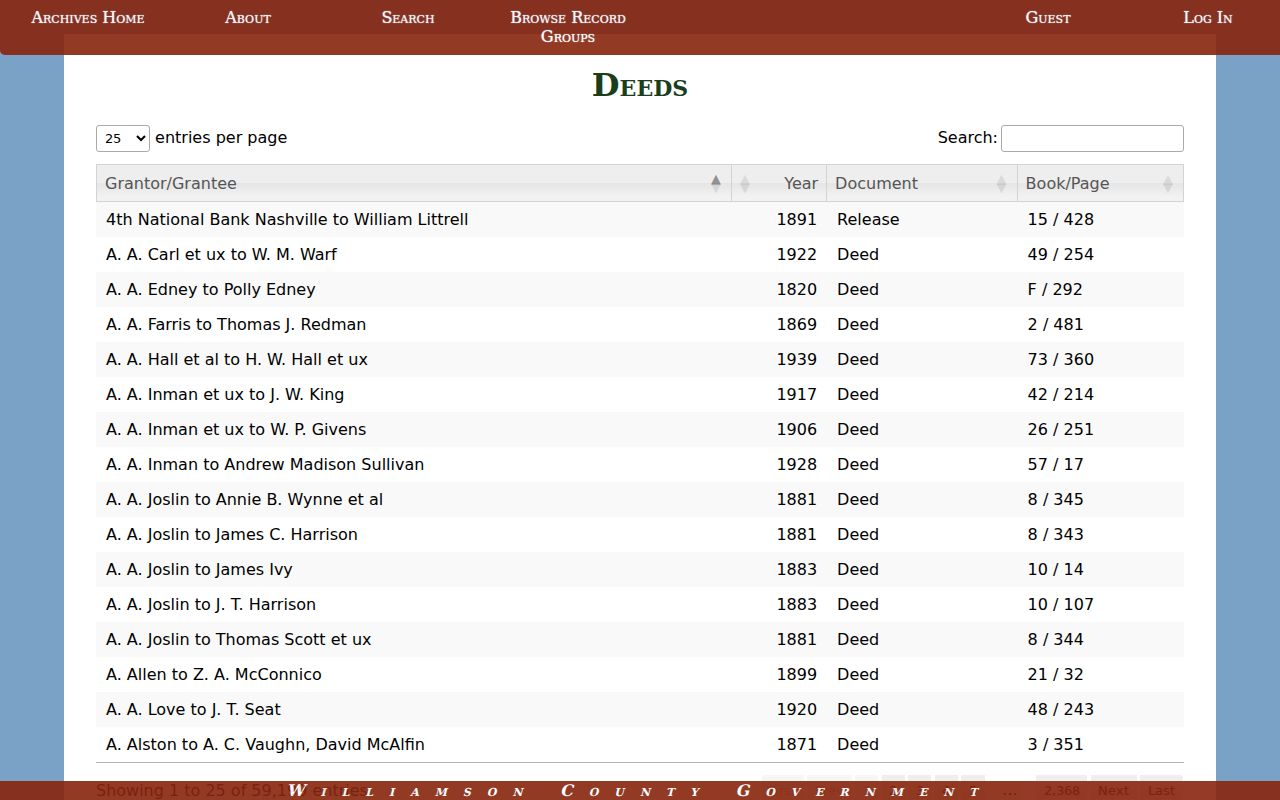
Its grantor or grantee, year, document, and book/page columns provide the reference needed for staff retrieval, but the result itself is not a certified deed. Some browse dates are clear metadata outliers, including a truncated tax year and a future obituary year, so verify the cited original.
Williamson County Deed Records Handoff
Land research divides at a local cut line. The official historic-property instructions send post-1966 deed work to the Register of Deeds. Pre-1966 deeds are indexed and available on microfilm at Archives, though the archive browse also lists scattered entries from 1786, 1792 through 1963, and 1977. Begin with the modern custodian when tracing a recent chain, then carry the grantor, grantee, legal description, and book/page reference into the older collection.
A grantor transfers an interest; a grantee receives it. Search the grantee on one deed as a possible grantor on the next conveyance. The Register counter is the fallback when the modern index lacks a usable hit, the image is unavailable, or a certified copy is required. Archives staff and microfilm supply the older route. Neither an assessed owner nor a historic index entry alone proves the full current chain.
Use the handoff. Ask the Register about recent instruments and certified copies. Use Archives references and microfilm for the earlier chain.
Access Williamson County Court Records
Williamson County trial records must be routed by court and case class. The Circuit Court Clerk keeps Circuit and General Sessions files. The Clerk and Master handles Chancery and current probate matters. Juvenile Court has a separate clerk and tighter confidentiality rules. Circuit Civil became paperless on July 1, 2022, but that fact does not make every filing open or place older matters in one public portal.
Give the clerk a full party name, spelling variants, a rough filing year, and the case type. A case number sharply improves the request. Ask for the docket first, which is the event list for a case, before ordering selected pleadings. The local fallback includes a phone or counter request, archived-file retrieval, and plain or certified copies. A certified copy bears clerk authentication; a web printout does not.
The state Public Case History search covers appellate matters, not all Williamson County trials. Its one search term can be treated as a case number, case style, party name, or business or organization. Stated coverage begins with appeals whose records were filed after September 1, 2006, and linked documents generally reach filings after August 26, 2013. Older appellate material requires the appellate clerk.
Route Williamson County Property Records
The county deliberately separates three property functions. The Property Data Search routing page sends assessment, personal-property, and Greenbelt questions to the Property Assessor. It sends deeds and plats to the Register of Deeds, while tax balances and payments go to the Trustee. This split matters because a parcel card is not deed text, and a deed does not state the live tax balance.
The county-linked property assessment search is the online route for parcel and valuation evidence. Exact live field labels were not confirmed, so do not assume a result supports every form of owner, mailing-address, or transfer search. The Assessor's office and a focused request remain the fallback. County GIS confirms parcel-number and county-boundary layers, while the Trustee maintains a separate tax application.
Tennessee's statewide parcel program expressly does not maintain Williamson County parcel data. The county Assessor and GIS route therefore carries the local role. Even then, assessed owner and occupant are not synonyms. A trust, estate, company, spouse, agent, or earlier assessment cycle can stand between a name on the roll and a person at the situs, which means the physical property address.
Williamson County Vital Records Boundaries
Tennessee separates certified certificates from the underlying local file. The Williamson County Clerk holds current local marriage-license material. A divorce decree and pleadings remain with the Circuit Court Clerk. Tennessee Office of Vital Records issues statewide birth, death, marriage, and divorce certificates, while county health departments can issue Tennessee birth or death certificates registered statewide.
The state charges $15 for each certificate or a no-record search letter. Mail requests need a signed application and either a copy of qualifying identification with the requester's signature or a notarized application. Applicants outside ordinary family categories must document a legal right. Birth certificates become public after 100 years. Marriage and divorce records over 50 years are directed to the county clerk and may also be held by the Tennessee State Library and Archives.
Tenn. Code Ann. §68-3-205 allows verified facts from authenticating documents but protects medical and confidential sections. Cause-of-death access also has an entitlement rule. The Tennessee Vital Records office, the county health department, the County Clerk, the court clerk, Archives, and TSLA therefore serve different needs. Public status never means every certificate field is open to everyone.
Note: A marriage certificate summarizes an event; it does not replace the county license packet or a court file tied to the same people.
Williamson County Records Custodian Offices
Franklin is the county seat and the main records hub. Contact the office that created or maintains the exact series. Calling first helps confirm whether a file is online, at the counter, archived, on microfilm, or stored off-site. It also lets the requester separate an informational copy from a certified one before cost or retrieval work begins.
Williamson County Register of Deeds
1320 West Main Street, Suite 201
Franklin, TN
615-790-5706
Monday through Friday, 8:00 to 4:30
Williamson County Circuit Court Clerk
Judicial Center
135 Fourth Avenue South
Franklin, TN 37064
615-790-5454
Monday through Friday, 8:00 to 4:30
Williamson County Archives and Museum
611 West Main Street
Franklin, TN
Historic records, Reading Room, and remote copies
The County Clerk, Property Assessor, Clerk and Master, Election Commission, county health department, and Trustee complete the core custodian network. The county's public directory supplies phone routing when an office has moved staff or divided work across locations. Current marriage licensing goes to the County Clerk, assessment questions to the Assessor, and current probate pleadings to the Clerk and Master.
Williamson County Law Enforcement Records
The general county request form does not handle arrest or law-enforcement records. Williamson County Sheriff material must use the Sheriff's separate public-record request form and coordinator. Police reports from Franklin or another municipality go to that city agency. No current official broad county jail roster was verified, so the proper fallback is an agency request rather than a claim that custody records do not exist.
State lookups are separate. The Tennessee Department of Correction runs the felony offender locator. The TBI registry allows combined optional terms such as name, alias, address, city, ZIP, offender ID, status, offense, and a Williamson County filter. Registry profiles can change and are updated daily. TBI directs corrections through the registering agency and warns that misuse for threats, intimidation, stalking, or harassment may lead to criminal prosecution or civil liability.
Lawful use only. Open records do not grant permission to contact, threaten, track, intimidate, or harass a listed person.
Verify Williamson County Recording Alerts
The Register links a vendor-hosted Recording Alert service for Williamson County. It can flag a possible new instrument tied to registered search terms, but the vendor says its materials are provided as is and that users remain responsible for accuracy. The alert site is not managed by county government and does not use county privacy or security policies.
The Williamson County Recording Alert service shows the enrollment and notice interface used for this early-warning channel.
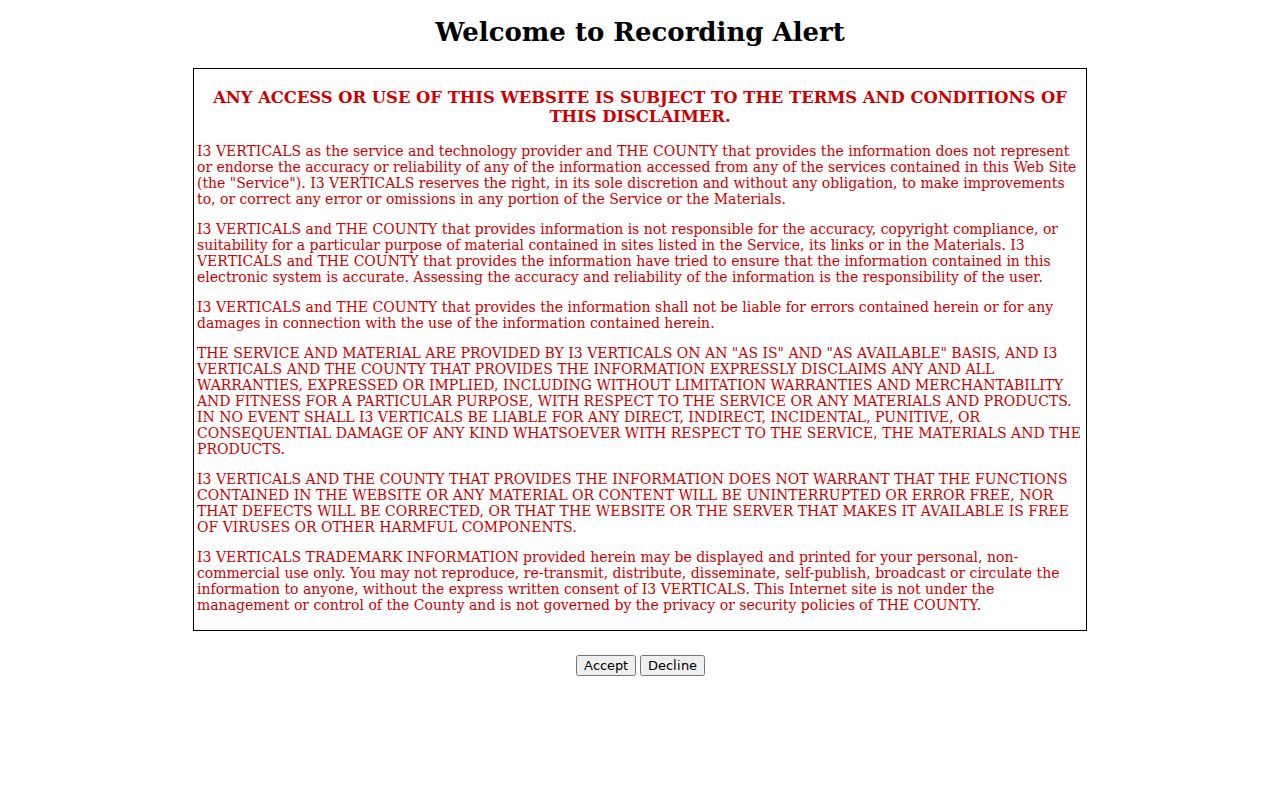
Treat any email or notice as a lead. Verify the instrument number, indexed parties, document type, and recording reference with the Register before drawing a conclusion or responding to a payment demand.
Request Williamson County Public Records
The Tennessee Public Records Act, Tenn. Code Ann. §§10-7-501 through 10-7-516, gives Tennessee citizens access to existing open government records. It does not force a custodian to answer questions, build a new list, or recreate a file that does not exist. Inspection cannot be charged, though proof of Tennessee citizenship may be required. Written copy requests may carry authorized page, labor, redaction, media, delivery, or other policy-based costs.
- Identify the creating office and record series. Add names and variants, a date range, record type, and any case, parcel, instrument, or book/page number.
- Check the official index. Then ask whether the office terminal, counter, microfilm, or stored file covers more years or images.
- Use the Williamson County request channel for general county records, and provide citizenship proof if requested. Send city, school, or law-enforcement requests to the separate custodian.
- Choose inspection or copies. State plain or certified, preferred delivery, and a cost limit; available preferences include pickup, first-class mail, electronic delivery, or another feasible method.
- Track seven business days. The custodian must produce the records, deny in writing with a legal basis, or provide a written estimate of the additional time reasonably needed.
General requests may be emailed to WCPublic.Records@williamsoncounty-tn.gov or mailed to Public Records Request Coordinator, Williamson County Government, PO Box 1006, Franklin, TN 37064. The county form excludes schools, municipalities, and law enforcement. Williamson County Schools uses its district route, municipal files go to the relevant town or city, and Sheriff requests have their own form and coordinator at 408 Century Court.
If a dispute remains, the Tennessee Office of Open Records Counsel explains the process and may informally assist. Judicial enforcement proceeds through an appropriate circuit or chancery court. Preserve the request, any proof sent, the response, cost estimate, and the exact exemption cited.
Williamson County Records Access Terms
Small differences in records language can change which source or copy is useful. These terms keep a Williamson County search focused when staff ask what form of access is needed.
- Custodian
- The office responsible for keeping and responding for a particular record series.
- Index
- A locator that points to a file, instrument, volume, image, or reference. It is not always the underlying record.
- Certified copy
- A copy authenticated by the authorized clerk or office, unlike an informational screen print.
- Exemption
- A law that permits or requires part or all of a government record to be withheld.
- Docket
- The dated event list for a court case, used to identify pleadings, orders, and other filings.
- Situs
- The physical location of land or improvements, which may differ from the owner's mailing address.
An index hit is often the most efficient starting point because it supplies the clerk's reference. A certified copy is the stronger endpoint when the record must carry official authentication. Asking for the right product can avoid paying for an entire file when only one deed, order, certificate, or docket entry is needed.
Williamson County Records Preservation Layers
Williamson County's records system has active, inactive, and permanent historical layers. Operating offices retain current material. The county completed a 20,000-square-foot secure Records Center for inactive departmental files in the fiscal year ending June 30, 2024. Archives staff manage retrieval, filing, disposition, and preservation there. The warehouse is not the public Reading Room, which remains downtown at the Archives and Museum.
Permanent historical records span original paper, bound volumes, microfilm, and scans. The Archives itself began in 1993, moved from the Five Points Post Office basement to the former public-library building in 2006, and continues adding index records and cross-references. In November 2025, the County Commission approved a $4,685 Tennessee State Library and Archives grant with no local match.
Coverage still varies by series. Deeds include material before county formation, marriages begin in 1803, wills in 1800, and probate in 1801, with gaps and different end dates. Williamson County was created from Davidson County in 1799, so early land or administrative work may also require predecessor-county or state sources. A gap in one index is not proof that a courthouse disaster destroyed the file; no authoritative evidence of a wholesale local courthouse loss was found.